
6.62 million
CORRUPTION INDEX (2024)35 / 100
CRIMINALITY SCORE6.22
total area85 km2
US$81.34 billion
FREEDOM OF THE PRESS (2024)53.55 / 100
RESILIENCE SCORE4.96
GDP PER CAPITA (2023)US$12 281.5
More about the Organized Crime Index
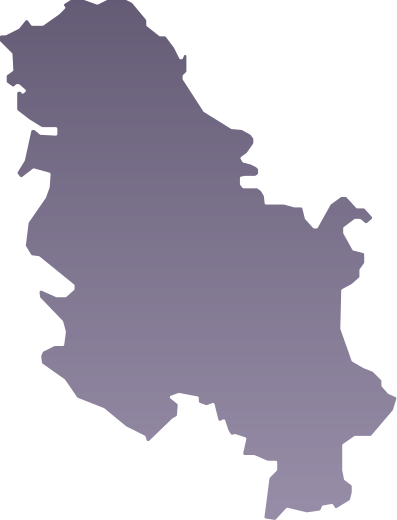
According to the 2023 Global Organized Crime Index, Serbia is heavily affected by organized crime, with the highest criminality score among the Western Balkan countries (6.22 out of 10). With a score of 7.0 for financial crimes, 1.02 points above the global average, Serbia is particularly affected by financial crimes, especially illicit financial flows (IFFs). One difficulty the country faces is that there is no official definition of IFFs in Serbia, which poses a challenge in combating the illicit transfer of money across national borders. The Western Balkan region, of which Serbia is a part, faces heightened vulnerability to IFFs as a result of its geographic location, socio-demographic profile, substantial informal economies, pervasive corruption, inadequate oversight of political financing, and restricted space for independent media and civil society.

Civil society plays a crucial role in exposing illicit financial activities and can provide valuable support in initiating legal proceedings against corrupt elements of the system. Serbia has notable investigative media centres such as the Crime and Corruption Reporting Network (KRIK), the Centre for Investigative Journalism of Serbia (CINS), the Balkan Investigative Reporting Network (BIRN) and Insider. However, despite the media’s efforts, only a few cases have been opened by the prosecutor's office on the basis of information provided by journalists.
In Serbia, civil society organizations have been actively participating in the policy development process, particularly in identifying and understanding risks in the NRA since 2018. Civil society organizations participated in the updating of Serbia’s 2024 NRA, contributing to the analysis of sectoral vulnerabilities. Their input complemented the broader engagement of public institutions, private sector representatives, international experts and relevant organizations. Investigative journalists, who are an integral part of civil society, serve as a crucial counterbalance to the executive, upholding the rule of law and democratic values. Civil society can contribute to effectively preventing, exposing and combating IFFs in following ways:
Serbia does not define IFFs in its legal framework and policies. At the same time, the clear identification of risks in the 2018, 2021 and 2024 NRAs has enabled supervisory bodies to subsequently improve standards for supervision in accordance with FATF recommendations. Previously, Serbian authorities have published several reports and policy documents addressing money laundering and terrorist financing, including NRAs and Action Plans in 2018 and 2021, as well as National AML/CFT Strategy (2020–2024) and the National AML/CTF Action Plan (2022–2024).
Serbia’s 2024 NRA extends beyond money laundering and terrorist financing to assess risks related to the financing of weapons proliferation and sector-specific vulnerabilities, reinforcing the need for comprehensive, risk-based mitigation across the entire financial and non-financial system.
The 2024 NRA identifies Serbia’s real estate sector as particularly high-risk, with criminals exploiting high-value assets for money laundering by using the services of public notaries, real estate intermediaries, legal professionals and accountants. Additionally, illegal construction activities present a major vulnerability, as numerous cases involve unverified sources of financing. Although the risks of money laundering and terrorist financing are well known, some issues remain unaddressed, such as the fact that a significant percentage of real estate transactions are conducted in cash. In the first six months of 2023, for example, cash payments accounted for 80% of real estate transactions without a bank loan, while only 7% of the total value of €3.3 billion in immovable assets was financed through loans.
Serbia has given attention to strengthening cooperation with international counterparts, particularly in the context of mutual legal assistance. This reflects collaboration between Serbia's FIU and the financial intelligence units of other countries and extends to broader inter-agency cooperation at the international level. The Law on Mutual Legal Assistance in Criminal Matters clearly defines international mutual legal assistance in criminal matters and is complemented by the Law on Seizure and Confiscation of the Proceeds of Crime and its framework for cooperation in the recovery of the proceeds of crime, which covers both temporary and permanent confiscation. Overall, the prosecutor’s office has improved the handling of international mutual legal assistance through participation in judicial networks, bilateral cooperation, promotion of informal collaboration and capacity strengthening, including specialization in international mutual legal assistance.
Collaborative efforts in law enforcement include a memorandum of understanding (MoU) signed in 2016 between the tax administration and the police on the exchange of information. The FIU actively engages with counterparts in the Western Balkans and internationally, participating in annual meetings to discuss money laundering and terrorism financing. As a member of the Egmont Group since 2003, Serbia’s FIU facilitates bilateral links. According to Serbia’s 2024 NRA, international cooperation remains a crucial element in combating money laundering. Serbian authorities received 106 mutual legal assistance requests from foreign jurisdictions and sent 77 requests to counterparts globally, having signed over 40 bilateral MoUs. Cooperation with foreign FIUs was particularly active, with the highest number of exchanges involving Montenegro, Bosnia and Herzegovina, Germany, Slovenia and Malta. The FIU uses international channels such as Europol, the Secure Information Exchange Network Application and the Camden Asset Recovery Inter-agency Network for information exchange.
International cooperation under Serbia’s 2024 NRA highlights that information exchange requests largely addressed money laundering and high-risk predicate offences such as drug trafficking, tax evasion and corruption. Strengthened collaboration with foreign tax authorities, notably in Croatia, Slovakia and Slovenia, resulted in the detection of significant tax evasion cases linked to money laundering threats.
In Serbia, several supervisory bodies are mandated to address IFFs, including the National Bank of Serbia, the Securities Commission, the FIU, the Ministry of Trade, the Games of Chance Administration, the Chamber of Public Notaries and the Bar Association.
Serbia lacks legislation directly addressing IFFs, as most laws and policies relating to financial crime focus on money laundering and terrorist financing. Civil society, the media, and the private sector play an important role in curbing IFFs by raising awareness of the damage they cause to society. In Serbia, the Law on the Prevention of Money Laundering and the Financing of Terrorism outlines the responsibilities of obligated entities in the implementation of measures against money laundering and terrorist financing.
The private sector plays an essential role in curbing illicit financial flows, as private companies make up the majority of obligated entities worldwide. In 2021 to 2023, reporting entities, mainly banks, money service providers and public notaries, reported a total of 5 067 suspicious transactions.
In addition, private sector partners also played a key role in enhancing the effectiveness of measures and identifying risks within Serbia’s AML/CFT system. Supported by the Serbian Chamber of Commerce, civil society (including NPOs), and sectoral associations such as the Bankers’ Association, direct communication with private sector actors enabled an objective and impartial assessment of changing risks over the reporting period.
The Administration for the Prevention of Money Laundering (APML) is the key authority responsible for tackling IFFs in the country. The APML plays an important role in early detection of IFFs, sharing intelligence with law enforcement agencies such as the prosecutor's office, organized crime division, customs and tax police.
The APML has the authority to collect financial intelligence from obligated entities, request data from relevant authorities and disseminate information to law enforcement.
However, the APML is an administrative type of financial intelligence unit and therefore does not have authority to conduct investigations. While APML staff is well trained and technologically proficient, there is a shortage of suspicious transactions reports from obligated entities, particularly from designated non-financial businesses and professions, such as lawyers, accountants and auditors.
Prosecutors lack expertise in financial intelligence and rely heavily on the APML to build cases. Delays in the exchange of information between the APML and law enforcement or tax authorities pose a challenge.
Serbia's system for investigating IFFs is intricate, involving entities such as the Office of the Higher Prosecutor, police units for economic and organized crime, the tax police, the Military Security Agency, and the Security Information Agency. The Prosecutor’s Office for Organized Crime is also responsible for investigating money laundering by organized criminal groups, which adds to the complexity of the jurisdiction.
The analysis of predicate crimes in Serbia highlights significant financial threats linked to money laundering. According to Serbia's 2024 NRA, a total of 120 criminal offences were identified as predicate crimes, generating illicit financial gains that could be laundered. The estimated total illicit proceeds from these crimes amounted to approximately €1.07 billion, combining both detected and undetected illicit assets.
According to the 2024 NRA, Serbia has a comprehensive legal framework governing the temporary and permanent confiscation of assets originating from criminal activities. The confiscation framework is defined by Articles 91 and 92 of the Criminal Code, while security measures are outlined in Article 87 and the Law on Seizure and Confiscation of Proceeds from Crime.
The EU Progress Report for Serbia 2024 stresses that the systematic and effective confiscation of criminal assets must be prioritized, requiring consistent tracking of money flows, proactive financial investigations, and full application of extended confiscation measures in money laundering and organized crime cases.
An independent administrative body, the Directorate for the Administration of Seized Assets under the Ministry of Justice, is responsible for the management of assets. Although seized assets are prioritized for sale, they can be reused for humanitarian purposes if they are not sold within a year. For example, the Centre for Human Trafficking Victims Protection was allocated a seized facility for social reuse, demonstrating social reinvestment. Confiscated vehicles are intended for use by public authorities.
According to Serbia’s 2024 NRA, the largest amount of confiscated assets in Serbia is recorded in cases involving organized criminal groups, with a total of €21 million seized, representing 12.72% of all confiscated assets and 23.5% of the total assessed money laundering threat from organized crime offences. The confiscation rate in these cases is higher than the global average. Additionally, significant amounts of assets were discovered and prosecuted in money laundering cases linked to predicate offences such as tax crimes and abuse of the position of responsible persons.
Civil society and the media play an important role in broader efforts to counter IFFs in Serbia. According to the Law on Associations of the Republic of Serbia, associations are voluntary, and several natural and/or legal persons are needed to establish non-governmental non-profit organizations, which then become legal entities upon entry in the register of associations. The 2021 NRA records 37 969 active non-profit organizations registered in Serbia, including 36 883 associations and 1 086 foundations and endowments.
To enhance the overall approach to countering IFFs in Serbia, several measures are recommended:


